
Networking Event Material Research at Aufschnitt – Design Week Berlin 2026
Design Week Berlin 2026 transformed Studio Aufschnitt on Boxhagener Straße into a place of exchange and encounter. Material research, natural fibres, circular economy, peatlands and leather made from plants – topics that rarely make it onto big stages, but that's exactly where transformation begins: in conversation, in listening, in cross-disciplinary thinking. Five talks, five perspectives, one common thread: how do new materials come into the world – and what role does design play in that?
We invited scientists, artists and communicators who work at very different points along the textile value chain. People who work daily on the questions that will shape our industry over the coming decades. What's hidden inside the plant? What happens to textile waste? What does a material feel like that no one has encountered before? And what does a peatland have to do with design?
Speaker
Patrick Engel, Head of the Nonwovens Competence Centre at the Saxony Textile Research Institute (STFI) in Chemnitz, opened the evening. STFI is an independent industrial research institution with a range of equipment unique in Europe – all nonwoven formation and consolidation processes under one roof. A large playground for material research. His talk used concrete examples to show how technical textile applications and design find each other – and why design work invites us to question established technologies and look at them from entirely new angles.
Dr.-Ing. Carsten Lühr from the Leibniz Institute for Agricultural Engineering and Bioeconomy (ATB Potsdam) posed one of the evening's most fundamental questions: what's actually inside the plant? His talk gave insights into the technological developments around the processing of natural fibres from agricultural biomass – from flax and hemp to wet meadow biomass and residual materials from entirely different production chains. From agricultural production to industrial application, covering a wide spectrum of fibre qualities, with one clear message: haptics and aesthetics play just as decisive a role today as technical requirements.
Morgan-Lee Wagner, Communications, Partnerships & PR at revoltech in Darmstadt, presented LOVR™ – a plant-based, plastic-free alternative to conventional leather. Not conceived as a niche product, but scalable and industrially applicable. Her talk circled around the question behind every new material: how does an idea become a real product? And why is it not enough for a material to merely sound innovative – it must also feel right, be applicable, and perform credibly in real products.
Hagar Napadow, Project Manager at Re:Fresh Global, made clear just how large the problem is – and how concrete the solution can be. Less than 1% of the approximately 92 million tonnes of textile waste generated worldwide each year is currently recycled. Re:Fresh Global counters this with an enzymatic process that transforms mixed textile waste into two new raw materials: Re-SanPulp™ for nonwovens and textiles, and Re-Celloop™ for cosmetics and packaging. The licensable SmartUp™ System turns this into modular micro-factories – scalable, regionally deployable and job-creating. Her talk showed how design becomes a bridge between sustainability, industry and aesthetics.
Daniel Hengst, artist from Leipzig, closed the evening with the title that raised the most questions – and sparked the most conversation: "Cuddling Bogs." Since 2019 he has been exploring peatlands artistically – through VR works, light and sound installations, texts and most recently soft sculptures made from sustainable bog materials. For centuries peatlands were considered useless, drained and destroyed. Today they are back in focus as massive CO₂ emitters. Together with science, industry and design, Hengst investigates the textile use of cattail – and asks how new forms of use can emerge that keep humans, plants and animals equally in mind.
Sponsorship
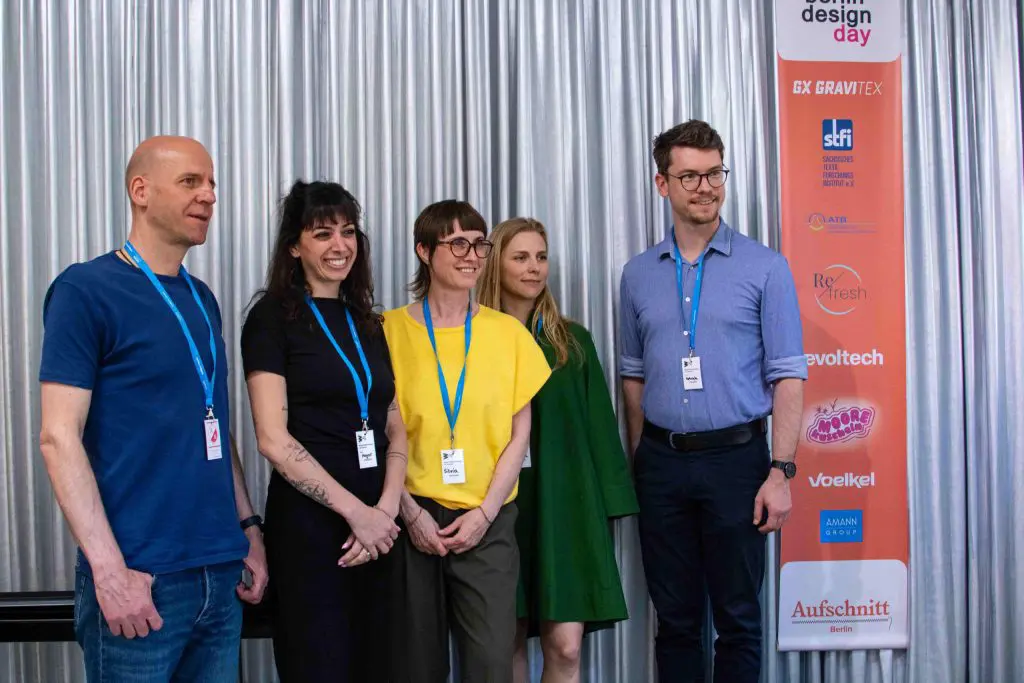
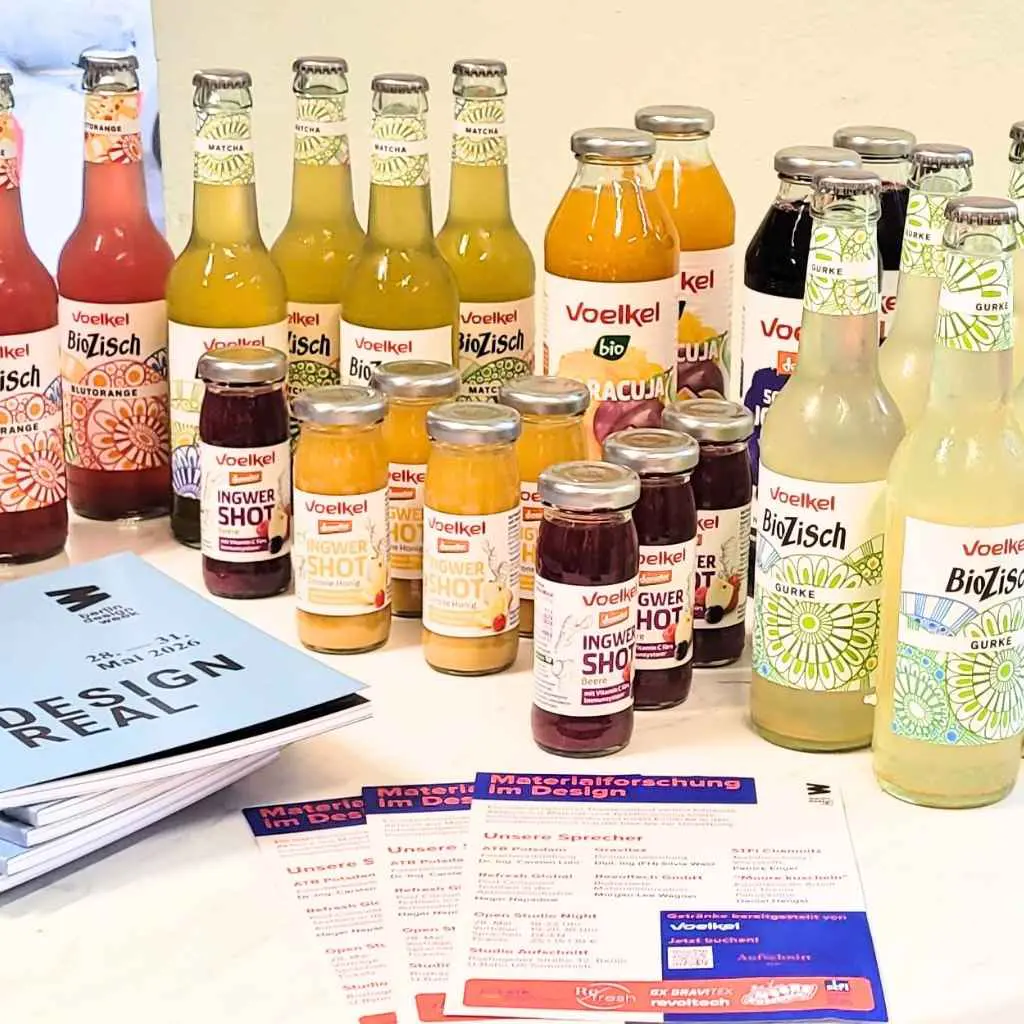
Voelkel From the Wendland region of Lower Saxony came the drinks – ginger shots, lemonades in matcha, cucumber and rhubarb, passion fruit and blackcurrant juices. Organic, colorful, refreshing. And gone before we knew it. A family business that has been committed to biodynamic farming for over 100 years – with the same passion as on day one.
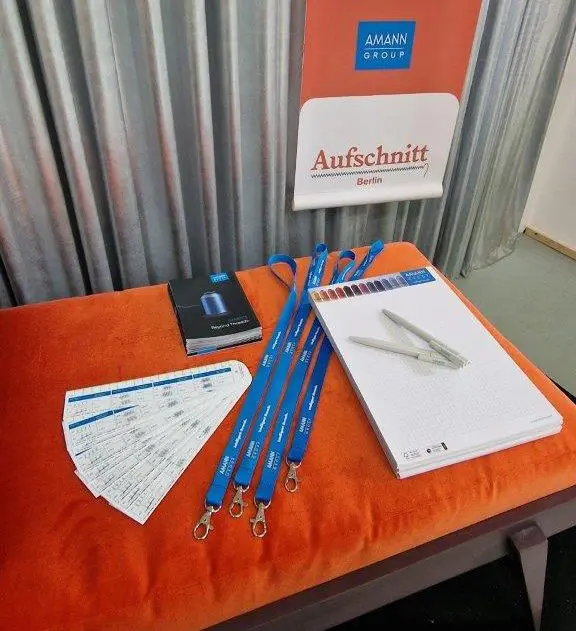
The AMANN Group A company from Bönnigheim covered the printing costs and provided lanyards, notepads, pens, and chewing gum. Since 1854, they have been one of the world's leading manufacturers of sewing and embroidery threads – and a fixture at Silvia's studio for years. Her favorite tool: the small gauge with all the information on thread requirements for each stitch type.
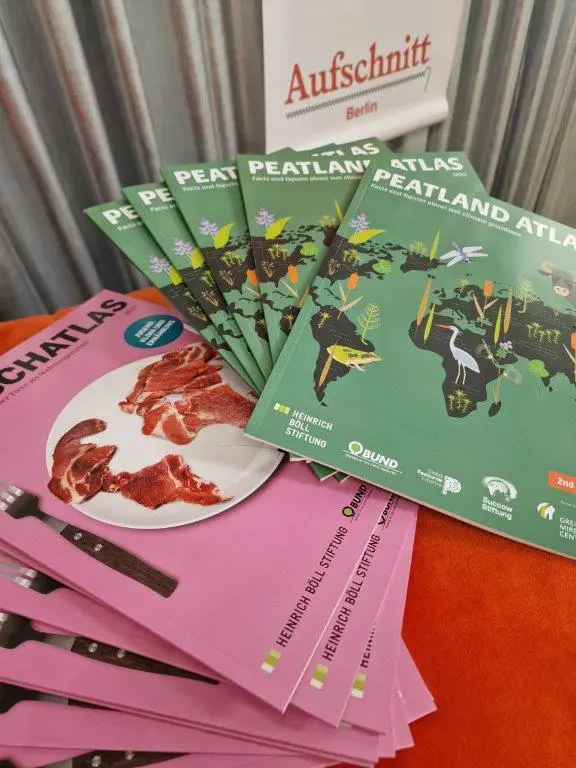
The Heinrich Böll Foundation provided the peatland atlas and the meat atlas – fittingly, given Daniel Hengst's presentation and Silvia's passion for vegetarianism. Both are still available at the studio. Just drop by Boxhagener Straße and ask.
Studio Aufschnitt – 20 Years. And we're continuing.
For two decades, Studio Aufschnitt has been a place for niche topics that touch and change our society. Topics along the textile value chain that rarely make it onto big stages – but that build bridges between science, design and industry. We believe that anyone who understands how a material comes into being makes different decisions.
If you enjoyed the lecture series – we are continuing. From within our network, we can develop a wide range of topics along the textile value chain: new speakers, new perspectives, new connections. This work takes time and intensive preparation. If you would like to support us financially, we would be very grateful for a donation.
Reference: Nachhaltigkeit
Reference: Sustainability Account: Silvia Wald Bank details available on request
Thank you