
From Quarks to Comfort – Our Collaboration with Tüftel Lab Berlin
Sometimes a collaboration begins with an idea, sometimes with a sketch – and sometimes with a very simple question: What could a piece of furniture look like that feels like a subatomic particle?
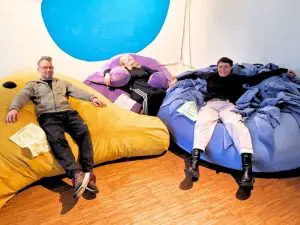
Together with Tüftel Lab Berlin, we took on this small but mighty question and realized a textile project that sits somewhere between science and softness: giant, organically shaped bean bags, inspired by the forms of subatomic particles.
Research Meets Form
The idea grew out of an interdisciplinary educational project that invited young people to make physical concepts tangible through the medium of textiles. The inspiration: quarks, bosons, gluons – the invisible, made shapeable in oversized softness.
Our brief was clear: to design objects together with the participants that would carry the theme in both form and function. The result: textile sculptures that serve simultaneously as seating furniture and playfully invite discourse about science, material and spatial design. textile sculptures, which simultaneously serve as seating and playfully invite discourse on science, materials and spatial design.
The Path to Form
In the In the appendix, we document the production process. In the appendix, we document the production process – from the first attempt at form through prototyping to the final realization. The challenge: developing textile constructions that not only work aesthetically, but also remain functional and durable. Every piece was tested, adjusted and optimized in close exchange with Tüftel Lab – true to our motto: thinking in fabric.
The seating objects were subsequently presented as part of a public installation – as part of an interactive exhibition on the theme of "Matter and Model".
Perspectives for the Future
The collaboration with Tüftel Lab opened up not only new topics for us, but also new tools – both figuratively and literally. The connection between pedagogy, design and craft has shown how much potential lies in free form – especially when young people help shape it.
We thank Tüftel Lab Berlin for their trust, the shared process and the openness to let theory become a piece of textile.
More impressions from the workshop and insights into the making process can be found in the appendix of this post.
Step 1: Product Development
- Receiving the drawing from the client
- Prototyping
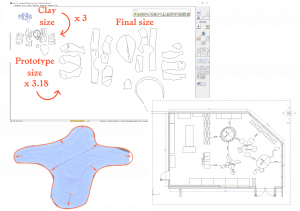
- Cutting out shapes and transferring them to paper
- Measuring the shapes
- Drawing lines to create the forms
- Transferring the shapes using plastic film and pins
- Transferring the shapes into a digital file
- Converting the digital drawing to a CAD programme
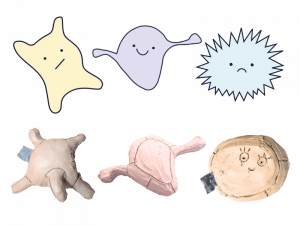
Step 2: Prototyping
- Cutting and sewing the fabric
- Filling the prototype
- Final adjustments
- Cutting the fabric
- Sewing the fabric
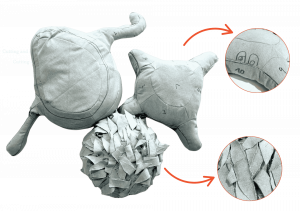
Step 3: Scaling to the Desired Size
- Quality control of the lines and parts of the 3D model
- Checking the pattern pieces on the 3D model
- Scaling the pattern pieces of the digital model for each part
- Quality control of the parts to check how they interact in space and defining the final size
- Adjusting the size to the form
Step 4: Filling the Fabric Giant
- Completion by introducing the filling material
- Celebrating with the client